Time Zone Basics Guide
Time Zones Explained: Clocks, Sunlight, and Global Time
Before you schedule across countries, it helps to understand why the world uses time zones, why there are about 24 main time zones, and why clocks change during the year.
What this guide answers
Three simple questions explain most time zone confusion.
Learn why the world is organized around 24 primary time zones, how UTC offsets work, and why some countries use half-hour or quarter-hour differences.
Why do time zones exist?Understand how Earth’s rotation, daylight, travel, business, and global communication created the need for standardized international time zones.
Why do clocks change?Discover how daylight saving time affects international meetings, changing UTC offsets, seasonal scheduling, and global business coordination.
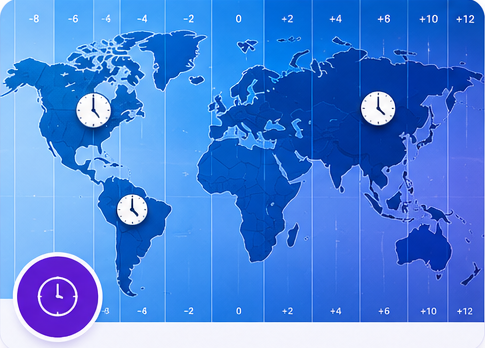
There are 24 main time zones across the world.
The world is commonly organized around 24 main time zones because Earth rotates once every 24 hours. As the planet turns, different regions face the sun at different times.
Each main time zone roughly represents one hour of difference from the next region. That is why New York, London, Tokyo, and Sydney can all be living in the same day but reading very different local clocks.
Real life is more detailed than a perfect 24-zone grid. Some countries use half-hour or quarter-hour offsets, and some large countries use several time zones across their land area.
When one side of Earth faces the sun, another side is already in evening or night.
Why do time zones exist?
Time zones exist because local sunlight changes as Earth rotates. Noon is not the same moment everywhere. When the sun is high over one region, another region may be waking up, working late, or already asleep.
Before standardized time zones, many towns used local solar time. That worked for small communities, but it became confusing as railroads, travel, business, and global communication expanded.
Time zones created a shared system. They make it easier for people to plan flights, run businesses, schedule calls, and coordinate across countries without calculating every city from scratch.
Why do clocks change?
Clocks change in places that use daylight saving time. During part of the year, those regions shift the clock forward or backward to move daylight into different parts of the day.
This can create confusion for international meetings because not every country changes clocks, and the countries that do change may not switch on the same date.
A meeting that was five hours apart one month may become four hours apart temporarily. That is why global scheduling should be checked with city-based time rather than memory or abbreviations.
Some clocks move ahead by one hour.
Some clocks move back by one hour.
Real meeting example
One meeting can feel normal in one city and painful in another.
A 9:00 AM meeting in New York may be convenient for London, but it can be late at night in Tokyo. That is why comparing local times before sending an invite matters.
This is why the best meeting time is not always the first overlap you find. It should also respect how reasonable that time feels for each person.
Common mistakes
Time zone basics prevent expensive scheduling errors.
EST, CST, GMT, and similar labels can be misunderstood. City names are clearer.
Daylight saving time can temporarily change the offset between two cities.
A technically available time may still be too early or too late for a real person.
Quick answers
Time Zone Basics FAQ
Are there exactly 24 time zones?
There are 24 main hour-based time zones, but real-world offsets include half-hour and quarter-hour variations.
Why not use one global time?
A single global time would make local daily life confusing because sunrise, lunch, work, and evening would happen at very different clock hours around the world.
Why does daylight saving time affect meetings?
It changes the time difference between cities, especially when one country changes clocks and another does not.
Plan with confidence
Ready to compare cities instead of guessing?
Use Best Meeting Time to compare local times, review overlap windows, and choose a better time before sending the invite.